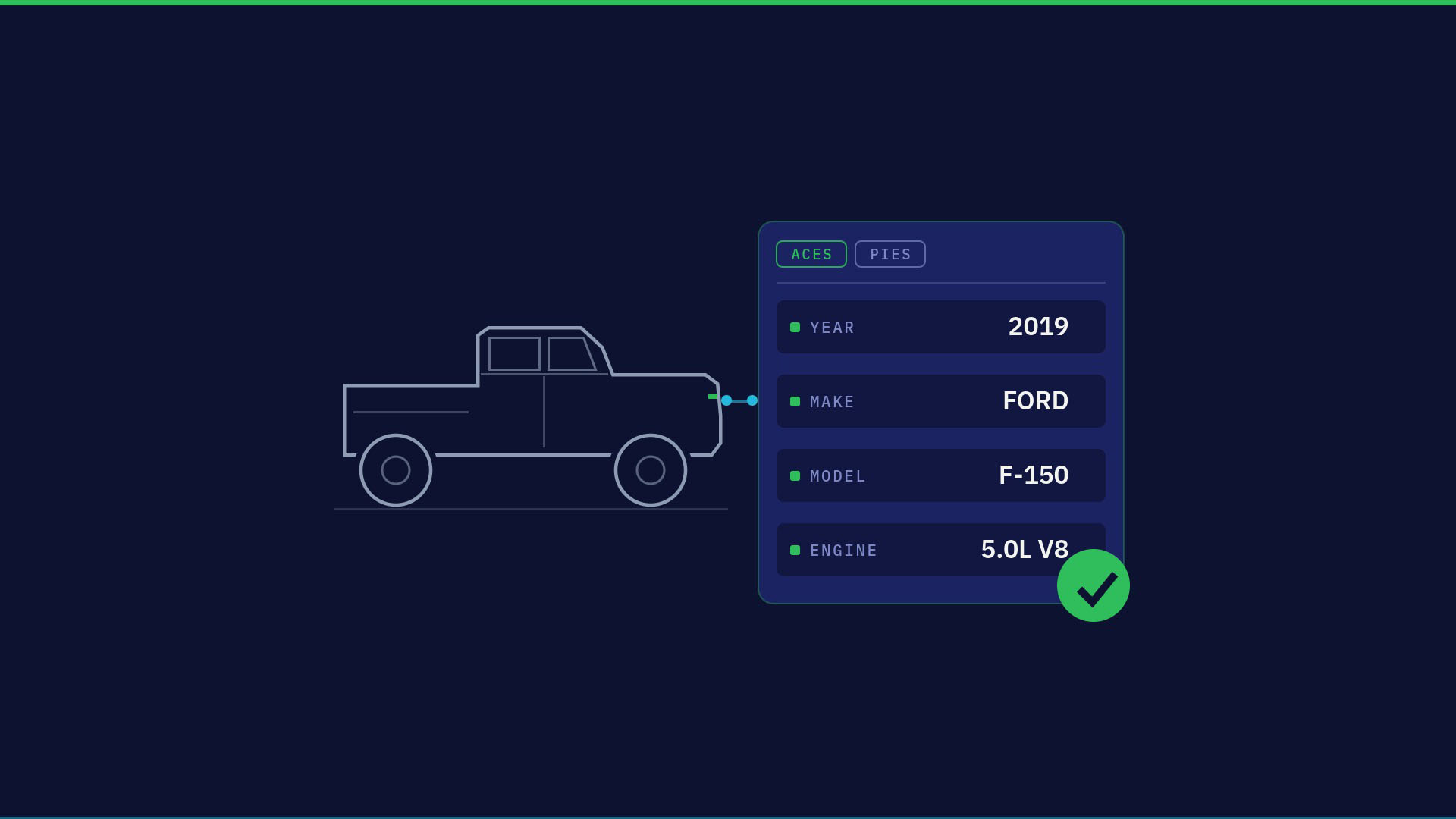
Shopify reported that AI-driven traffic to its stores grew 8x year over year in Q1 2026, with orders from AI searches up nearly 13x. For parts merchants, the answer engine optimization (AEO) conversation is inherently a fitment data conversation. An AI shopping agent can't recommend a brake rotor if it can't verify the part fits a 2019 F-150.

What we heard at DotDev
At Shopify's DotDev conference in Toronto last month, the theme from Tobias Lütke was AI and the Shopify Catalog. As Tobi put it, great companies will be built on top of the Shopify Catalog API. The Catalog is becoming the repository of product data for all merchants, not just Shopify merchants.
The Catalog API makes your products discoverable by default in ChatGPT, Microsoft Copilot, AI Mode in Google Search, and the Gemini app, with agentic storefronts handling the selling side. Shopify's own framework for agentic-ready product data comes down to two things: machine-parsable data an AI can query directly via MCP, the Model Context Protocol, and real-time accuracy on price and inventory.
Fitment is math, not a soft attribute
Tobi also made a point about soft attributes: the non-mathematical qualities of products, like fashion. Fitment metadata is predominantly math. If your data is properly structured, AI models can verify fit accurately instead of guessing. That single fact makes auto parts one of the best-positioned verticals for agentic commerce.
A model recommending a jacket has to interpret taste. A model recommending a control arm only has to match a year, make, model, submodel, engine, and drive type against a table. Parts is the rare category where the agent can be right, provably, every time. That only holds if the table is readable.
The fitment data problem
Most Shopify parts stores keep fitment in a year/make/model search app or in metafields built for on-site filtering, not for AI models to read your catalog. The filter works great for a human clicking through dropdowns. It does nothing for an agent that never loads your collection page. If the models recommending parts can't read your fitment, it may as well not exist.
Structure fitment against ACES and PIES
The industry standards ACES and PIES for product information exist exactly for this. Four moves get your catalog readable:
- Structure fitment against ACES vehicle configurations in metafields, rather than only in free-text descriptions or a sealed-off app database.
- Complete your PIES-compatible product attributes: brand, MPN, GTIN, and the spec details agents use to compare parts.
- Expose key fitment consistently across the surfaces machines actually consume: structured data, product content, Shopify Catalog mappings, and any product feeds.
- Keep pricing and inventory accurate in Shopify, because the Shopify Catalog continuously syndicates those values to AI shopping channels. Incorrect pricing or inventory can propagate across multiple AI experiences fast.
Structure it once, and it is readable everywhere. That is the whole point of the standard: you are not writing a separate integration for ChatGPT, Copilot, Gemini, and whatever ships next quarter. You are writing to a schema those engines already consume through the Catalog. The same work also lifts your broader AEO position in AI search results.
Why this matters before SEMA
The Specialty Equipment Market Association (SEMA) Show runs November 3-6 in Las Vegas, and we expect AI and product data to dominate the conversations the way they dominated DotDev. Gartner predicts 20 percent of transactions will run through AI platforms by 2030. Our read of the SEMA market report pointed the same direction: the aftermarket's data problem is now a discovery problem.
Structured fitment is not a Q4 project you can start in October. Mapping a real catalog to ACES vehicle configurations takes weeks, and the audit that tells you how far off you are takes days. Merchants who start now walk into Las Vegas with a catalog agents can already read.
Get your catalog agentic ready
At Ambaum we have worked with aftermarket parts merchants on Shopify Plus for years, and fitment data is where we spend much of that time. If you want your catalog agentic ready before SEMA, hit us up for a fitment and AI readiness audit.
Read the full transcript
Fitment data is your AEO strategy. Your next auto parts customer might be an AI agent, and an agent can't recommend a brake rotor it can't verify fits a 2019 F-150.
Shopify reported AI-driven traffic to its stores grew eight times year over year, with orders from AI searches up nearly 13 times. And Gartner predicts 20% of transactions will run through AI platforms by 2030.
At Shopify's DotDev conference, the theme from Shopify's CEO was clear: great companies will be built on top of the Shopify Catalog API. The Catalog makes your products discoverable by default in ChatGPT, Microsoft Copilot, Google's AI Mode, and Gemini.
Here's the good news for parts merchants. Fitment is math, not a soft attribute like style in fashion. Structured data lets an AI verify fit accurately, which makes auto parts one of the best-positioned verticals for agentic commerce.
The problem is where fitment lives today. Most parts stores keep it in a year/make/model search app or in metafields built for on-site filtering. If the models recommending parts can't read it, it may as well not exist.
The fix is the industry standards ACES and PIES. Map fitment to ACES vehicle configurations in metafields. Complete your PIES attributes. Expose fitment everywhere machines read, and keep price and inventory accurate, because the Catalog syndicates those values to every AI channel.
The SEMA Show runs November 3rd through 6th in Las Vegas, and AI will dominate the conversations. At Ambaum, fitment data is where we spend our time. Want your catalog agentic ready before SEMA? Reach out for a fitment audit today.