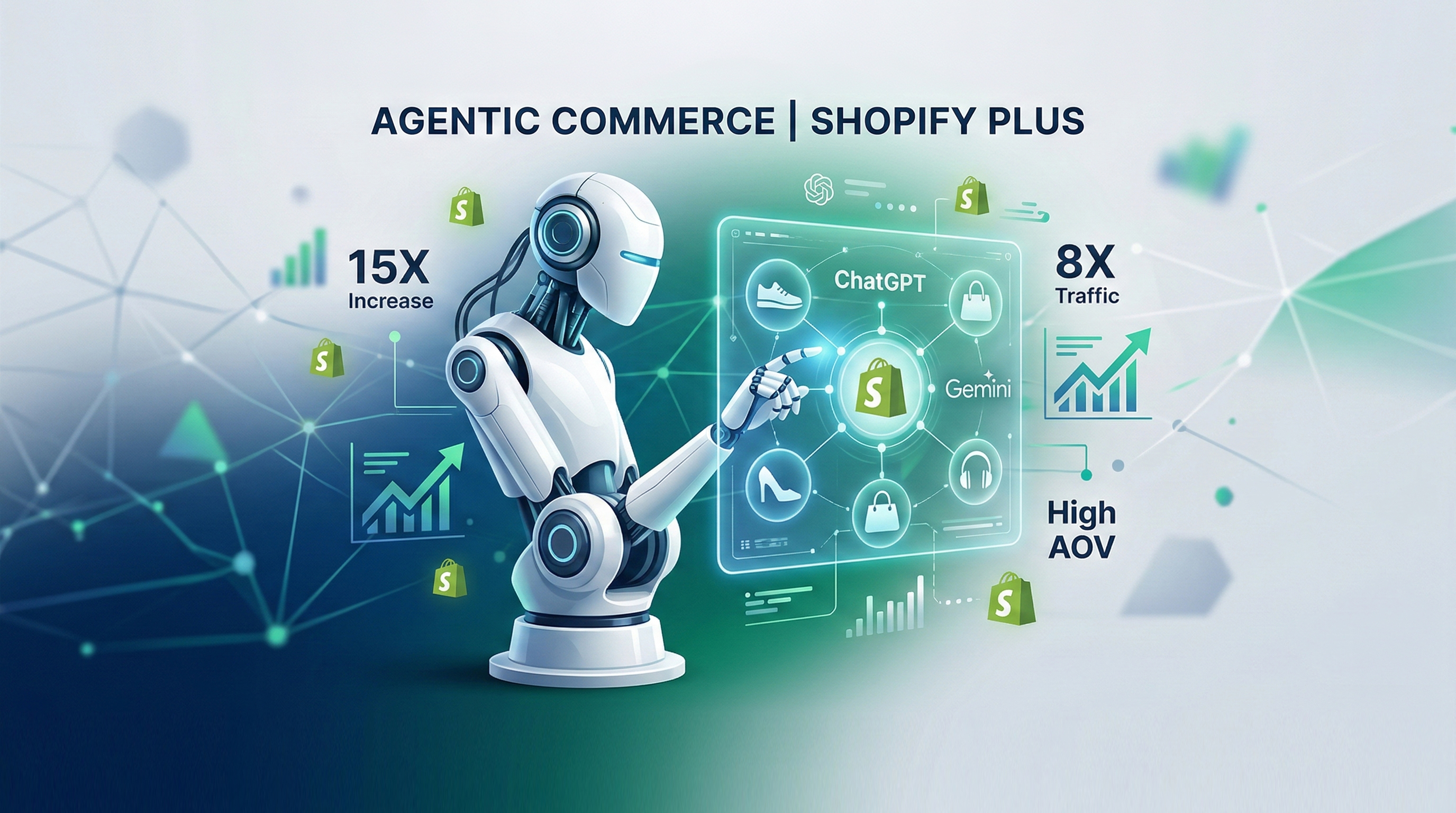
The era of passive e-commerce is over. At the recent Shopify Agentic Commerce Webinar, the data confirmed a massive shift in consumer behavior: from January 2025 to January 2026, orders originating from AI searches increased 15X.
For Shopify Plus merchants, this "Renaissance" means your storefront is no longer just a destination. It is the data infrastructure powering transactions across the entire AI ecosystem.
Defining the Agentic Stack
To compete in 2026, CTOs and E-commerce Directors must distinguish between these core technologies:
- Agentic Commerce: The macro shift of selling through AI models like ChatGPT, Gemini, and Perplexity.
- Agentic Storefronts: Shopify’s specific product enabling distribution into AI channels. This acts as a secondary, headless layer distinct from your web storefront.
- The Agentic Plan: A new solution for non-Shopify brands to access the Shopify Catalog and AI distribution without a full migration.
Critical Infrastructure: Catalog Mapping
AI agents rely on structured data to "understand" and recommend your products. If your data is messy, your brand is invisible to the models.
- Global Catalog Integration: Merchants must complete data mapping in the Shopify Admin to feed the global catalog.
- Combined Listings Tool: Vital for products with high variant counts. Use custom metafields to aggregate variants, ensuring agents see a unified, coherent product entity rather than fragmented listings.
High-Signal AI Tools for 2026
Shopify has released several first-party tools to bridge the gap between human intent and AI execution:
- Sim Gym: An AI research preview that uses "shopper agents" to simulate customer behavior. This allows you to validate theme changes and navigation structures against AI-driven personas before going live.
- Knowledge Base App: This app is the "brain" for your AI shopping agents. It allows you to manage brand-specific FAQs and policies that are exposed exclusively to AI models, ensuring on-brand responses in conversational commerce.
- Sidekick App Extensions: Developers can now build custom admin extensions. Sidekick has evolved from a chatbot into an operational co-pilot capable of generating functional mini-apps and executing complex workflows via natural language.
Performance Benchmarks
The shift to agentic commerce is driven by high-intent traffic. Data shows that AI-driven traffic to merchant stores has grown 8X year-over-year. More importantly, the Average Order Value (AOV) from AI models is consistently higher than direct site traffic, as agents effectively filter for the most relevant, high-value matches for the consumer.