Shopify reported third quarter 2026 results on November 3rd, and a large share of the earnings call was about AI shopping. The financials were solid again, but for merchants the useful part is what Shopify said about how shoppers now arrive from AI channels, what those channels reward, and the first signs of agents buying on a shopper's behalf. Below are the five takeaways we would act on, with the quarter over quarter context from our Q2 2026 earnings breakdown.
If you want the hands-on side first, see our guides to testing your store with an AI shopping agent and Shopify's Catalog mapping tool.

The headline numbers
Shopify's Q3 press release puts the quarter in a few lines. All figures are for the three months ended September 30, 2026, compared with the same quarter of 2025.
- GMV: $119.1 billion, up 29% year over year (30% in constant currency)
- Revenue: $3.74 billion, up 32%
- Free cash flow: $816 million, a 22% margin, up from 18% a year ago
- Merchant Solutions revenue: $2.91 billion, up 35%. Subscription Solutions: $836 million, up 20%
- Monthly recurring revenue (MRR): $230 million, up from $193 million
Shopify's investor presentation adds that 68% of GMV ran through Shopify Payments in Q3, up from 65% a year earlier. For Q4, Shopify guided to revenue growth at a low-thirties percentage rate.
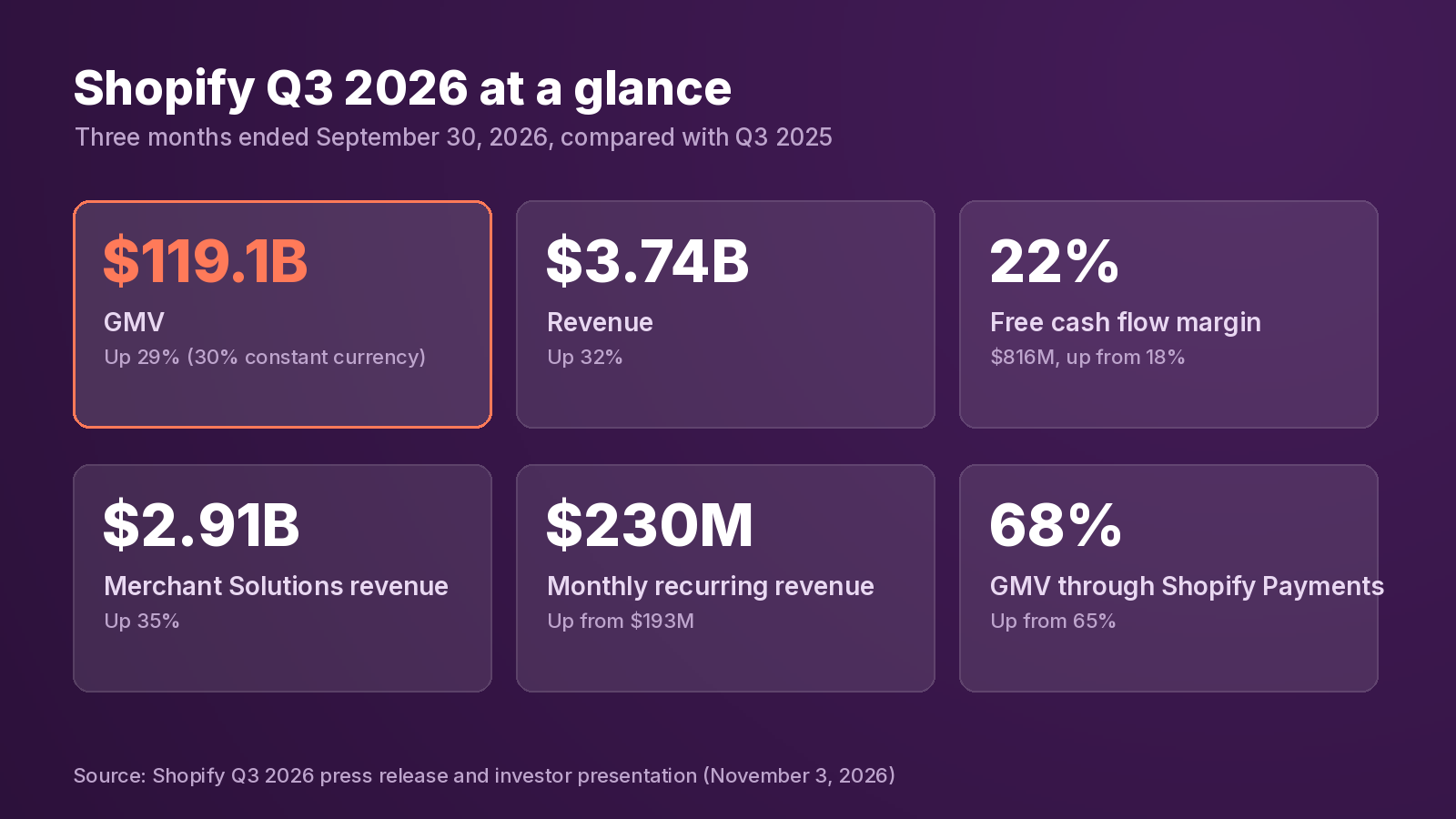
Shopify Q3 2026 at a glance. Source: Shopify Q3 2026 press release and investor presentation.
Compared with Q2, growth cooled slightly on the top line (GMV growth went from 32% to 29%, revenue growth from 34% to 32%) while the free cash flow margin improved from 18% to 22%. Merchant Solutions keeps outgrowing subscriptions, which means the growth is still coming from merchants selling more, not from plan pricing. Solid quarter. Now the part that affects how you run your store.
1. Your product page is now your landing page
On the call, Shopify President Harley Finkelstein said AI channels are sending shoppers straight to product pages at 3x the rate of organic search, and that those shoppers convert 64% more often. Shopify's investor presentation shows the same +64% conversion figure for AI-referred sessions compared with organic search.
In Q2, Shopify described this as roughly half of AI-referred sessions landing on a product page, versus about 20% for traditional search. The direction has not changed. AI agents skip your homepage and your collection pages and drop the shopper on a single product.
Treat every product page as the first page a shopper sees. That means the page has to answer the buying question on its own:
- A title that names the product the way a shopper would ask for it
- A description that states the specs, compatibility, and exclusions in plain text
- Price, availability, shipping, and return terms visible without clicking away
- Images that show the actual product, not only lifestyle shots
What this does not mean
It does not mean your collection pages stop mattering. Organic search, paid social, and email still send shoppers there. It means the product page can no longer lean on the collection page to explain context.
2. Get specific: 74% came from outside the top 100 categories
Finkelstein said 74% of AI-attributed purchases in Q3 came from outside Shopify's top 100 categories. Elsewhere on the call, Shopify put it as three quarters of AI-referred sales. In Q2 Shopify reported 75%, so this is now a pattern across two quarters, not a one-off.
Here is the number most merchants will skim past: AI channels reward specificity. Finkelstein described AI channels surfacing "highly specific products that fit specific customers with a specific need." Broad, popular categories are not where agent recommendations win.
For a catalog-heavy store, detailed product data now matters more than broad collection pages. If you sell aftermarket parts, the attribute that decides the sale (year, make, model, position, exclusions) needs to live in text an agent can read, not only in a fitment widget or a metafield. We covered why in our fitment data post.
3. Find out what Shopify Catalog is sending you
Shopify said searches powered by Shopify Catalog convert at 2x the rate of general AI search, which Finkelstein later described as "what people call scraping." Shopify describes Catalog as a structured dataset built from more than 1 billion product pages, with live pricing and inventory, that turns details like size, color, and material into values an agent can read.
You can see part of this in your own admin. Per Shopify Help:
- Go to Sales channels › Agentic.
- In the search preview, open Queries where your products appeared, or Top search queries, and click a query to see how your products rank.
- Review your Shopify Catalog product count, or the reason your store is not eligible.
- Check how your product details map to Catalog under the mapping settings.
Shopify Help calls the search preview a directional signal, not an exact prediction, because each AI channel re-ranks results with its own logic. Treat each check as a snapshot and write down what you see.
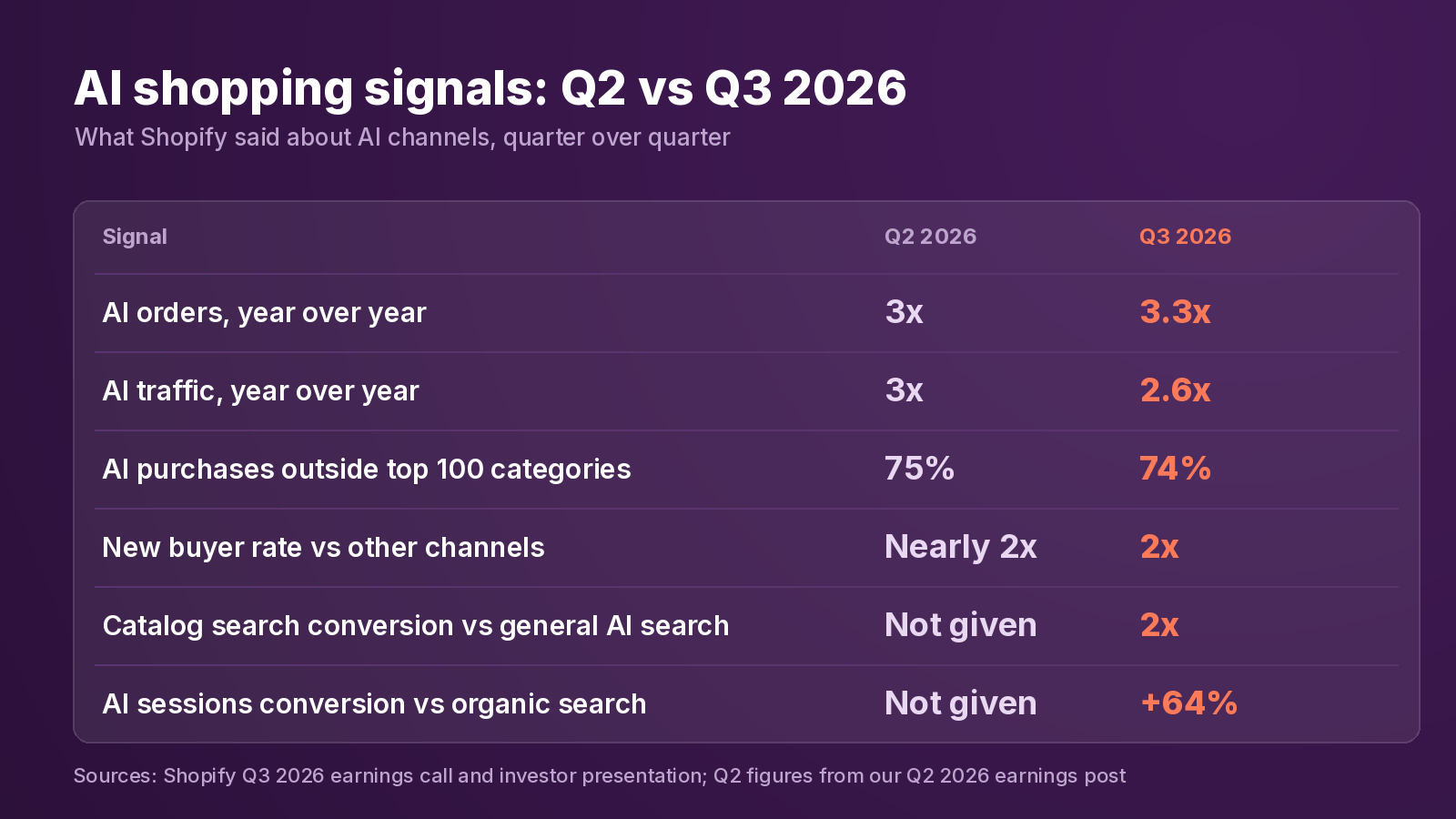
AI shopping signals, Q2 vs Q3 2026. Sources: Shopify Q3 2026 earnings call and investor presentation, and our Q2 2026 earnings post.
4. Agents are starting to buy
Shopify said Q3 was the first time it saw shoppers experimenting with delegated purchasing through personal agents, meaning agents that act on a shopper's behalf, with permission. Finkelstein named Shop, Shop Pay, and the Shop app as the trust layer: the agent uses the shopper's Shop account and saved Shop Pay wallet, and the agent never sees card details.
Two caveats. Shopify called agentic volume "still small," and it did not give a figure for purchases completed by agents themselves. So this is an early signal, not a channel to staff up for yet.
What you can do now is make sure an agent can parse the rules that block a purchase:
- Shipping: zones, cutoffs, freight or oversize rules, and delivery times stated in numbers
- Returns: the window in days, condition requirements, restocking fees, and any core return rules
- Exclusions: what you do not ship, and where
If a rule only lives in an image, a PDF, or a support macro, an agent cannot read it. Keep store policies current and use your knowledge base in Sales channels › Agentic for the non-product facts agents may quote.
5. AI orders grew 3.3x: plan for 2027
AI orders grew 3.3x year over year in Q3, while AI traffic grew 2.6x. Orders growing faster than traffic means the shoppers who do arrive from AI channels are converting better. Shopify's presentation also shows AI channels bringing new buyers at 2x the rate of other online channels.
Pull your Q3 orders by AI channel. Sales channels › Agentic shows how your products perform in agentic storefronts, and your order reports show the rest. Compare them with Q2 and with the same quarter last year. Then plan your 2027 catalog, content, and support work assuming that line keeps climbing.
Q2 to Q3: what changed
- AI orders: tripled in Q2, up 3.3x in Q3
- AI traffic: tripled in Q2, up 2.6x in Q3
- Share of AI purchases from outside the top 100 categories: 75% in Q2, 74% in Q3
- Landing on product pages: about half of AI sessions in Q2, 3x the rate of organic search in Q3
- New buyers through AI channels: nearly 2x in Q2, 2x in Q3
- New in Q3: Catalog-powered search converting at 2x general AI search, and the first delegated purchases through personal agents
What to do this week
- Open Sales channels › Agentic and write down the queries where your products appeared.
- Run the search preview for your top three products using shopper-style queries.
- Pick your ten best sellers and confirm the title and description answer the buying question without the collection page.
- Move any deciding attribute (fitment, size, compatibility) that only lives in a metafield into the description too.
- Rewrite shipping and return policies with numbers: days, fees, zones, cutoffs.
- Pull Q3 orders by AI channel and compare them with Q2.
- Add AI channel volume to your 2027 plan as its own line.
Where Ambaum fits
At Ambaum we read every Shopify earnings release and changelog so our merchants do not have to. If you want a second set of eyes on your product data, your Catalog mapping, or your policies before AI volume grows in 2027, reach out. You can also explore our AI Enablement services.
No pitch. No pressure. Just perspective.
Sources
- Shopify: Q3 2026 press release (November 3, 2026), Q3 2026 investor presentation, and the Q3 2026 earnings call webcast (November 3, 2026)
- Shopify Help: Managing agentic storefronts and Shopify Catalog and product discovery for agentic storefronts
- Q2 comparisons come from our Q2 2026 earnings breakdown, based on Shopify's Q2 2026 results.
Read the full transcript
Shopify reported third quarter earnings earlier this month, and much of the call was spent on AI shopping. Here's what Shopify merchants should take away. First, your product page is now your landing page. AI channels send shoppers straight to product pages at three times the rate of organic search.
Treat each one like the first page a shopper sees. Second, get specific. 74% of AI-attributed purchases came from outside Shopify's top 100 categories. Detailed product data now matters more than broad collection pages.
Third, find out what Shopify Catalog is sending you. Searches powered by Shopify Catalog convert at two times the rate of general AI search. In your admin, open Sales channels, then Agentic, to see the searches where your products appeared. Fourth, agents are starting to buy.
This was the first quarter Shopify saw shoppers try delegated purchasing through personal agents. Make sure your return and shipping rules can be clearly parsed by an agent. Fifth, AI orders grew 3.3 times year over year. Pull your third quarter orders by AI channel and start planning ahead for more AI agent volume in 2027.
Ambaum is here to help. Reach out with any questions.