
Meta's Muse hit #1 on the US App Store on September 18. Amazon blocked it from transacting. Shopify welcomed it with open arms and switched on Shop Pay checkout. Your store is probably already enrolled. Here is what that means and what to check this week.
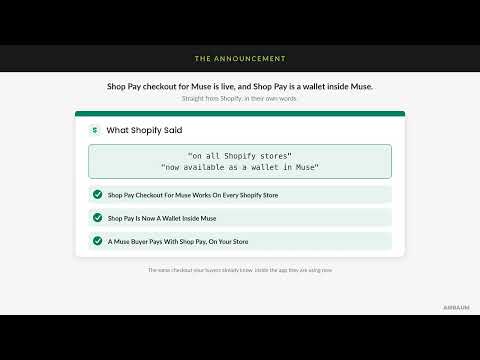
On September 18, 2026, Meta's Muse became the number one free app on the US App Store, ten days after launch. Two days later, Amazon blocked it from completing purchases on amazon.com. The same week, Shopify's CEO announced agentic checkout with Shop Pay, quote, "on all Shopify stores."
Your store did not have to do anything. That is the point. It is also the catch.
What happened, in order
The timeline matters because it explains the defaults you are living with now.
September 8. Muse launches. The same day, Shopify's changelog reads: "Meta is now an AI channel in your admin... Your products are shared with Meta by default through Shopify Catalog."
September 18. Muse hits #1 on the US App Store free chart, passing ChatGPT. Appfigures puts the first twelve days at 2.8 million downloads.
September 20 to 21. Amazon starts blocking Muse transactions on amazon.com. Amazon says Meta never notified them, the agent does not identify itself, and it appears to capture customer credentials. Amazon's stated principle: agents should operate openly and respect a provider's decision not to participate.
September 21. Shopify CEO Tobi Lütke posts that Shopify is partnering deeply with Muse to enable agentic checkout with Shop Pay "on all Shopify stores."
September 23. At Meta Connect, Mark Zuckerberg says Muse will be free for "a huge number of tokens" with the expectation that Meta will eventually profit "by taking a small fee from transactions." The fee lands on merchants, not users. No rate and no date yet.
So the scoreboard is simple: the top app in the country wants to buy, one giant said no, and Shopify said yes on your behalf.
Check 1: you are probably already enrolled
If your store is eligible, agentic storefronts are active by default. Meta direct checkout lives under Sales channels > Agentic in your Shopify admin, behind the master toggle "Allow Shopify to manage for me."
That toggle deserves a second look. It does not just cover Meta. It auto-enrolls your store in every future AI channel Shopify adds. Leave it on and you are opting into whatever ships next, sight unseen. We are not telling you to turn it off. We are telling you to know what it does, and to review it when each new channel arrives.
"All Shopify stores" is not literal. The actual eligibility, per Shopify's Help Center: your store sells to shoppers in the US, Canada, or Mexico; your products are eligible for Shopify Catalog; the Facebook and Instagram by Meta channel is installed with product sync on; you have accepted the Agentic Storefronts terms; and your store policies (terms, privacy, returns) are filled in under Settings. If your store is not in that bucket, nothing changes for you yet.
Check 2: what Muse can see in your catalog
Muse reads six fields from your catalog: title, description, variant options, images, price, and availability. That is the whole reading list. If it is not in those fields, Muse is not working from it.
Here is the number most merchants will skim past: required legal disclosures must sit in the first 6,000 characters of your product description. Custom metafields do not flow through on their own. They only reach the agent through Catalog Mapping into a standard field (title, description, category, tags, options, barcodes). If your fitment data or compatibility notes live in an unmapped metafield, the agent never sees them. We covered the same pattern for every other agent in our agentic product rewrites piece, and the rule is identical here: the description is what gets read.
Check 3: what Muse cannot buy
Four product types are not purchasable in Muse by default: bundles, customizable products, subscriptions, and B2B-only items. Also out: local delivery, in-store pickup, required customer sign-in, and custom checkout blocks.
Read that last one again if you are on Plus. Your checkout upsells, custom fields, loyalty blocks, trust badges, and validations may not render inside Meta's direct checkout. Required logic should live in Shopify Functions (shipping, discounts, cart and checkout validation), which do carry over, along with discount codes and automatic discounts.
And here is the uncomfortable part: a Muse shopper who cannot buy your bundle may buy someone else's. If a bundle drives real revenue, consider representing the popular configuration as a standalone SKU with its own title, price, and inventory.
Check 4: the fees are zero today, and not forever
Shopify's Help Center is explicit: there are no fees for selling in Meta's direct checkout beyond your standard payment processing fees. That is today's number.
Zuckerberg's number is tomorrow's: a small fee on completed Muse transactions, paid by merchants, at some unannounced date. Budget for it now so it is not a surprise when it lands.
Check 5: you are still the merchant of record
Orders land in your Shopify admin attributed to Meta. Fulfillment, returns, chargebacks, and support are yours. If the agent buys the wrong variant for a customer, the return is your return and the dispute is your dispute. Shopify has not published how agent-order disputes or Shopify Protect apply. Assume the liability is yours until they say otherwise.
Check 6: your analytics have a blind spot
Google Analytics and custom pixels do not fire inside Meta's direct checkout. Only server-to-server checkout events do. Shopify's agentic reports combine referral and direct-checkout sales, so attribute carefully or you will misread where the order came from.
Five things to check this week
- Open Sales channels > Agentic and confirm which channels are active. Decide whether "Allow Shopify to manage for me" stays on with your eyes open.
- Confirm your store policies are filled in (Settings > Policies) and the Agentic Storefronts terms are accepted, or you are not in the pool at all.
- Audit your top 20 product descriptions: complete titles, descriptions that carry the sale in the first 6,000 characters, current images, variant options, price, and availability.
- Map the metafields that matter (fitment, compatibility, materials) into standard catalog fields, or accept that agents cannot see them.
- Review your bundles, subscriptions, customizable products, and B2B items. Decide what a Muse shopper should see instead of a dead end.
The top app in the country can now buy from you. Make sure your catalog is ready for it.
At Ambaum we track every one of these agent channels so our merchants do not have to. If you want a second set of eyes on your catalog before the holiday rush, reach out.
No pitch. No pressure. Just perspective.
Read the full transcript
Shop Pay is now available as a wallet in Muse. Muse is Meta's new agent app, and this is a big deal for every Shopify merchant. So, here is what changed and what to check on your store.
Muse from Meta has been the top free app in the United States since September 18th. Consumers are using it to automate all kinds of tasks and purchases.
Amazon responded by blocking Muse from conducting transactions. Shopify welcomed it with open arms.
Shopify says Shop Pay checkout for Muse is available on all Shopify stores and Shop Pay is now available as a wallet in Muse. So when a Muse user buys from your store, they can pay with Shop Pay.
What can Muse see? It can access your Shopify catalog fields including title, description, variant options, images, price, and availability. If it is not in those fields, Muse is not working from it and Muse can already check out on your store.
Meta direct checkout under sales channels, then Agentic, is on by default for eligible stores for shoppers in the United States Canada, and Mexico.
On fees, Shopify says there are none beyond your normal payment processing fees. Zuckerberg has said he expects Meta to take a small fee from Muse transactions in the future.
One thing to review, bundles, customizable products, subscriptions, and B2B items will not be available to purchase in Muse by default. Check those before Muse shoppers go looking for them.
Questions about Muse in your Shopify store? Reach out to Ambaum. We are happy to help.