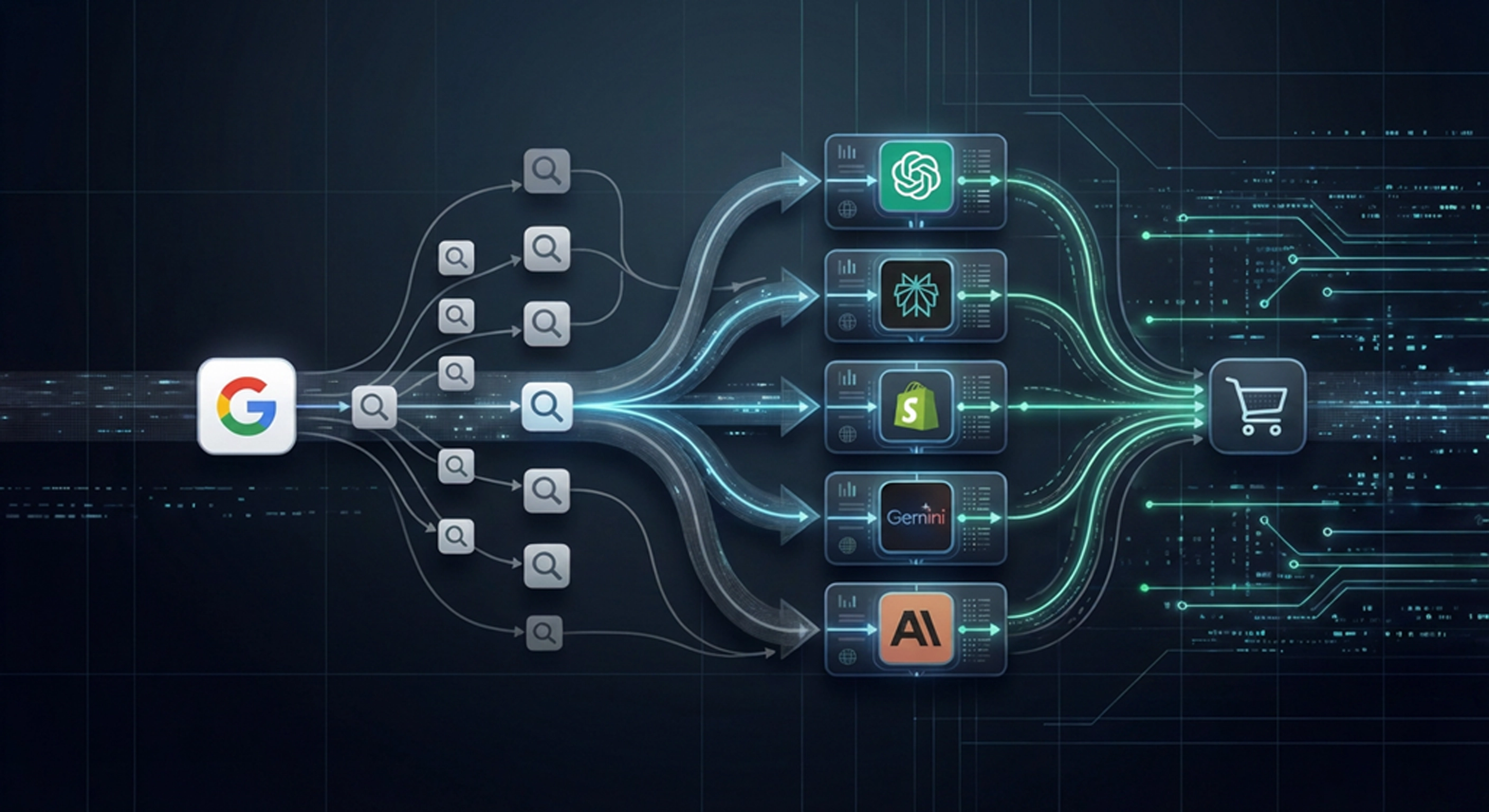
If you run a Shopify store and your Google organic traffic is not down this year, you might be the exception to a broader trend. Across 64 publisher sites tracked by Define Media Group, organic search clicks have fallen 42 percent since Google began expanding AI Overviews in May 2025. Reuters Institute and Chartbeat peg the global publisher decline closer to 33 percent, with US losses reaching 38 percent. KEO Marketing reports that 73 percent of B2B websites saw meaningful traffic losses between 2024 and 2025, with an average year over year decline of 34 percent. When Google AI Overviews appear, organic click through rates on the top ranked result drop 61 percent.
Here is the 6 month picture by the numbers:
- Google Organic Traffic - Down 33 to 42 percent from pre AI Overview baseline (Search Engine Land)
- LLM Referral Traffic - Up roughly 500 percent year over year from a small base (QuickSEO)
- Conversion Rate Delta - Semrush reports LLM visitors converting at 4.4x the rate of Google organic (Growth Engines summary)
The traffic lost on Google is being rerouted through ChatGPT, Perplexity, Gemini, Claude, and Copilot. Earlier this year I published an AI Readiness Assessment framework covering the foundational questions every brand needs to answer about schema, indexing, Merchant Center data flows, product page structure, and app hygiene. More recently, I built an OpenClaw Skill that samples 100 products from any Shopify store and checks whether they even show up in the Shopify Catalog API and MCP, which is how AI tools actually retrieve product data. Products with zero inventory and the "Continue selling when out of stock" toggle turned off are silently excluded from the catalog that AI models query.
The urgency here is real: AI assistants are already fragmenting how product discovery happens. Some models still read your storefront, schema, and PDP content from the open web, while others are moving toward AI-native commerce layers like Shopify’s Catalog API and other agent-facing retrieval systems. If your data is weak, inconsistent, or missing in either path, your products can disappear from consideration entirely. That means brands now have to operate on both fronts at once: a storefront that is clear, credible, and machine-readable, and a catalog layer that is fully surfaced for the agents and LLMs making recommendations. The brands that treat this like a future problem are at risk of becoming invisible in the exact moments customers are ready to buy.
The brands who invest in structured data hygiene, product page citability, and agentic commerce plumbing will compound as the conversion math already favors AI channels. Start with a baseline audit today and then run a focused AI Audit at 90 days to validate catalog visibility, schema coverage, and LLM referral tracking. Repeat at 6 months and 12 months, because the landscape is moving fast enough that a one time assessment ages out inside of two quarters. If you want Ambaum to help you run that check for you, reach out.
The 33 percent decline is the headline, but the real number is the conversion multiple on the other side. If AI referrals convert at 4.4 to 6 times the rate of Google organic, a brand that captures even a 5 percent LLM referral share in 2026 is economically ahead of where they were at 100 percent Google in 2024. The losers in this transition are the brands that ignore both channels. The winners are the brands that accept the redistribution, invest in the infrastructure, and show up where their customers are actually asking questions now.